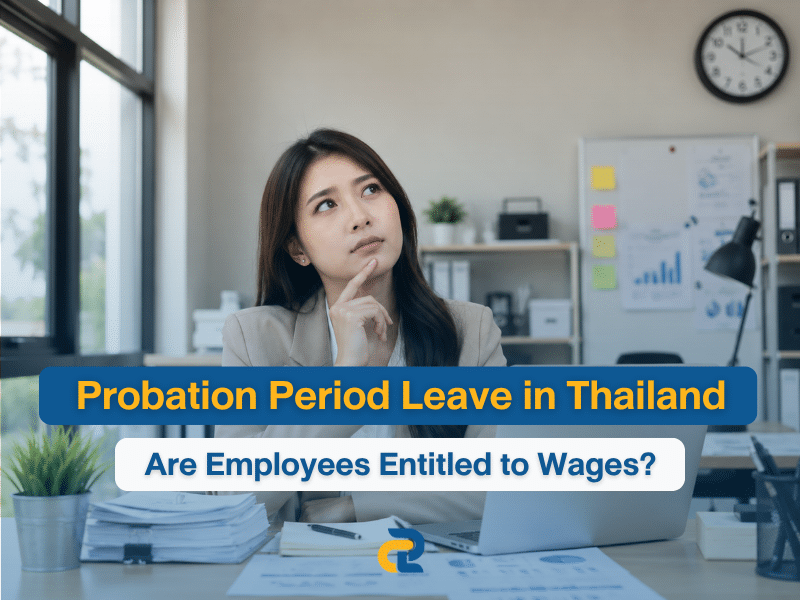
How about probationary period in Thailand? the employee leave rights that you should know.
What is the probationary period in Thailand?
The probation period is a period of time when both the employee and employer learn how to work together. The employee learns about the job and the company’s culture, while the employer learns about the employee’s work habits, personality, and whether they can fit into the organization. If the results are satisfactory, the employee can continue to work, or as we say “pass the probation.” However, if the results are not satisfactory, the employer can terminate the employment or extend the probationary period.
In fact, under Thai law, there are no clear regulations on the duration of the probationary period. However, according to Section 118 (1) of the Labor Protection Act, if the employer wants to terminate an employee who has worked for less than one year but has worked for 120 days or more, the employer must pay compensation to the employee at a rate not less than the last wage for 30 days. This means that if an employee has worked for 120 days but less than a year and is terminated, the employer must pay compensation at a rate of one month’s salary. Because of this regulation, most companies in Thailand set the probationary period at 119 days.
Read more: What kind of employment contract, termination cases, and how to pay compensation?
Leave regulations for the employee in Thailand
In Thailand, almost of employee there is a common misunderstanding that employees cannot take leave during the probationary period or if take leave then they will not receive pay for the days they take off. This has led to much debate about whether it is true or not. In this article, we will explain the rights of employees in these situations, specifically for sick leave and personal leave.

Sick Leave
There has been a common misunderstanding that if an employee is on probationary period, they will not receive payment if they take a sick leave. However, falling ill is not something anyone wants, and we cannot predict when we will become ill. To protect the health of employees, Thai law has regulations in place that allow employees to take sick leave and still receive payment for a period of 30 days per year. This applies to daily workers, regular employees, and those who are still in their probationary period. If the sick leave exceeds 30 days, it is up to the employer to decide whether or not to pay for the excess days.
It is important for employees to inform their employer as soon as possible when they are unable to work due to illness, and provide a medical certificate as evidence. The employer is required to pay for the sick leave according to the employment contract, which should specify the amount of sick leave that the employee is

Personal Leave
Previously, there have been disputes between employers and employees regarding personal leave, as Thai law does not have clear regulations regarding personal leave. This has resulted in daily workers or those on probationary periods not having the right to take personal leave. In practice, employers only pay for personal leave for monthly employees or those who have completed their probationary period. To address this issue, an amendment was made to the law in 2018, granting all employees the right to take at least 3 days of paid personal leave per year, or more if specified by the employer. The conditions for personal leave, such as the type of personal matters allowed, the procedure for taking leave, or the proportion of leave days per year, are at the discretion of each individual employer.
It is important for employees to communicate with their employer and provide advance notice when taking personal leave, to avoid any misunderstandings or disputes. Employers are required to pay for personal leave according to the employment contract, which should specify the amount of personal leave that the employee is entitled to.

Summary
In conclusion, all employees in Thailand have the right to take personal leave, and the amount of personal leave depends on the employer’s policy or the employment contract. It is important for employees to communicate with their employer and provide advance notice when taking personal leave, and to provide a medical certificate when taking sick leave.
Resource: Thai Government Labor Law
FAQs
Probationary employees are eligible to take sick leave and receive their regular wages. The Labor Protection Act stipulates that all employees—whether daily, permanent, or probationary—are entitled to this right.
They are entitled to at least 3 days of paid business leave per year for necessary personal matters.
Generally, employees who are still on probation are not yet eligible for annual leave. Although the law mandates that all employees are entitled to a minimum of 6 days of annual leave per year, it does not clearly specify when the organization must start granting this right. Therefore, it depends on each company’s policy, and most companies only grant annual leave after the employee has passed probation.
An employer has no legal right to forbid a probationary employee from taking sick leave or business leave. This is because the status of an “employee” officially and legally begins on the very first day both parties agree to work together. Consequently, probationary employees are protected under the Labor Protection Act just like regular permanent employees, which includes the right to 30 days of paid sick leave and 3 days of paid business leave.
The 119-day probation period does not directly relate to leave entitlements. Instead, it stems from Section 118 of the Labor Protection Act, which states that if an employee has worked for 120 days or more but less than 1 year, the employer must pay severance pay equal to 1 month’s salary upon termination.
Most companies therefore set the probation period at 119 days to avoid this severance pay obligation. However, sick leave and business leave rights remain legally protected throughout this entire period.