Can you legally hire someone in Thailand if your company has no Thai entity?
The answer is Yes — and more international businesses are doing it than you’d expect.
Thailand is one of Southeast Asia’s most attractive hiring markets. But registering a company can take 2–5 months — time most hiring decisions simply don’t have.
The good news: there’s a fully compliant way to hire in Thailand without setting up a company, lock up capital, or build a local HR team first.
In this guide, RLC breaks down what that path is, how it works, and when it’s the right call.
Key Takeaways
1. You don’t need a Thai entity to hire legally in Thailand. An EOR provides the legal employment structure — so you can hire compliantly without registering a company, locking up capital, or waiting months for entity setup.
2. EOR onboarding takes 2–4 weeks. Entity setup takes 2–5 months. For most hiring decisions, that time gap makes all the difference.
3. Compliance isn’t optional — and EOR covers it. Thai labor law, payroll tax, social security, work permits, and severance all apply from day one. An EOR handles every layer so you don’t have to build that expertise in-house before your first hire.
4. You manage the work, the EOR manages the employment relationship under Thai law. But there are a few limitations every company should understand before getting started.
How to Hire Employees in Thailand Without a Local Entity?
You don’t need to register a Thai company to employ people legally in Thailand. The most practical route is an Employer of Record (EOR) — a locally registered Thai company that employs workers on your behalf.
The EOR holds the employment contract, runs payroll, files taxes, contributes to social security, and manages work permits under its own Thai entity. Your company keeps full control of the day-to-day work. It’s a legally recognized structure, and for most companies entering Thailand, it’s the fastest compliant path to a first hire.
Benefits of Hiring in Thailand Without Setting Up a Company
1. Hire in Weeks, Not Months
With an EOR, employment contracts are ready quickly and new hires can be onboarded within 2–4 weeks. Entity setup takes 2–5 months minimum. If you have a candidate ready now, waiting often means losing them to a faster-moving competitor.
2. No Entity Setup or Registered Capital Requirements
Establishing a Thai company typically requires registered capital and additional setup costs before you can begin hiring. With an EOR, there is no need to set up a local entity or maintain registered capital. You simply pay a service fee covering payroll, compliance, and HR administration. That means lower financial exposure while you’re still testing the market.
3. Full Labor Law and Tax Compliance from Day One
Thai labor law, personal income tax (5%–35%), and social security contributions apply from the first hire. Getting any of it wrong creates real liability. An EOR manages contracts, payroll, tax filings, and severance — so you’re compliant from day one without a local HR or legal team.
4. Work Permit and Visa Support for Foreign Staff
Foreign nationals need both a Non-Immigrant B Visa and a Work Permit tied to a registered Thai employer. The EOR is that employer — handling applications, renewals, and 90-day reporting.
Enforcement is active: Between 2024 and 2025, authorities inspected more than 38,000 businesses, and penalties for violations ranged from THB 400,000 to 800,000. This is why having immigration experts on your team matters.
5. Flexibility to Scale or Exit
Hiring needs change over time. With an EOR, adding staff is straightforward, and leaving the market just means ending the EOR agreement instead of closing down a Thai legal entity. For companies that are still deciding whether to commit to Thailand long-term, this flexibility offers real, practical value.
EOR vs. Setting Up a Company in Thailand
EOR and entity setup aren’t either/or choices — they fit different stages of entering the market.
| EOR | Thai Entity Setup |
Time to first hire | 2–4 weeks | 2–5+ months |
Registered Capital | None | THB 2–3M registered capital typically required |
Payroll & tax compliance | Managed by EOR | Requires local HR/finance |
Work Permit sponsorship | Yes (EOR as legal employer) | Yes (your entity) |
Flexibility to exit | High — end EOR engagement | Lower — entity dissolution required |
Best for | Testing markets, small teams, fast hiring | Long-term operations, large headcount |
Is Hiring Without a Thai Entity Right for Your Business?
EOR isn’t the answer for every company, but it fits 3 scenarios particularly well.
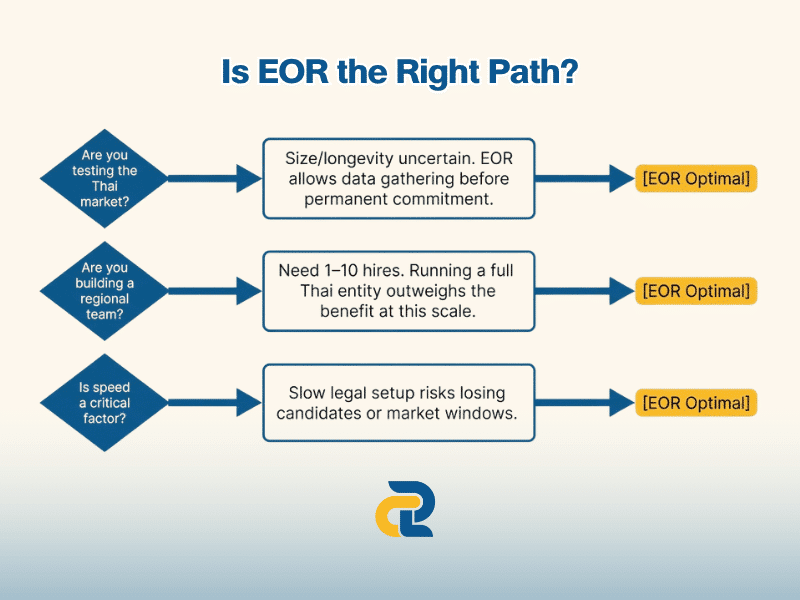
1. Companies Testing the Thai Market for the First Time
When the size or longevity of your Thai operation is still uncertain, an EOR lets you hire compliantly, assess the market, and decide on a permanent entity once you have real data.
2. Regional Teams That Need 1–10 Hires
At this scale, running a full Thai entity usually outweighs the benefit. An EOR provides the legal infrastructure without a local finance or HR function to maintain it.
3. Global Companies That Need to Move Fast
When a slow legal setup can cost you a candidate or a market window, an EOR compresses the timeline so your team focuses on the business, not the paperwork.
Limitations of Hiring Employees in Thailand Without Setting Up a Company
1. You’re Not the Legal Employer
You manage the work; the EOR manages the employment relationship under Thai law. In any dispute, termination, or audit, the EOR is the entity on paper — so alignment from the start matters.
2. Restricted Occupations for Foreign Workers
Thailand prohibits foreign nationals from certain roles in agriculture, accounting, legal services, architecture, and more. A competent EOR checks this before placement. Violations carry penalties up to THB 800,000 per worker.
3. Why the EOR Provider You Choose Matters
If a provider isn’t properly registered in Thailand, it cannot legally employ staff. One without in-house labor law and payroll expertise creates compliance issues that surface later — often during a dispute or a Revenue Department audit. The model is only as reliable as the provider behind it.
FAQs
Yes. Using an EOR, you can employ staff fully compliantly without registering your own Thai entity.
Typically 2–4 weeks, compared with 2–5 months for entity setup.
Yes. As the legal employer in Thailand, the EOR manages the Non-Immigrant B Visa and Work Permit application process, including renewals and 90-day reporting. Any government fees and related costs are typically borne by the client or employee, as agreed.
Summary
Hiring employees in Thailand no longer requires setting up a local entity. Through an Employer of Record (EOR), international companies can onboard staff compliantly within 2–4 weeks — without registered capital, without a local HR team, and without the 2–5 month wait that entity registration demands.
The EOR acts as the legal employer — covering contracts, payroll, tax, work permits, and labor law compliance — while you retain full control of the work. It fits especially well for companies testing the market, building small regional teams, or needing to move faster than entity setup allows.
Just remember: the model is only as strong as the provider behind it.
Ready to hire in Thailand without the entity overhead?
RLC manages EOR, payroll, and work permits in-house from Bangkok. If you want to understand what the process looks like for your specific situation — including timelines, costs, and compliance requirements — contact RLC’s team directly.